

Read Time: 5 minutes
Key Takeaways:
- OCR and RPA deliver stronger results in manufacturing when they run as one governed workflow that captures data accurately, validates it before posting, and gives teams clear control over what enters core systems.
- Capture accuracy depends on industry-tuned models and exception-first design, because generic OCR struggles with supplier-specific layouts. At the same time, rule-driven RPA keeps clean documents moving and sends real issues to the right owner.
- A well-governed automation workflow does more than reduce manual entry; it creates audit-ready logs, role-based approval controls, and real-time visibility across plants, enabling IT to scale automation without compromising compliance or accountability.
Most manufacturing teams don’t have a technology gap; they have an architecture gap. OCR (Optical Character Recognition) captures invoices and purchase orders. RPA (Robotic Process Automation) executes validated records into downstream systems. But when those two tools run independently, the space between them, unowned exceptions, unvalidated fields, unlogged routing decisions, is where errors accumulate, and audits get complicated.
The real gains from OCR and RPA for data entry automation come when both operate as a governed, industry-tuned workflow: accurate at capture, intelligent in exception routing, and visible to every stakeholder who needs to act. That’s the workflow iTech Data Services builds at Data Entry Automation.
How OCR and RPA Improve Data Entry Accuracy
OCR improves invoice and purchase order capture accuracy in manufacturing by reading documents directly at the source, eliminating the transcription errors that accumulate when operators rekey data across disconnected systems. The two technologies split the work cleanly: OCR extracts the data; RPA validates and acts on it.
OCR Extracts Data Directly From Source Documents
OCR pulls header fields and line-item data straight from invoices or purchase orders, removing the need for manual transcription. Research shows that line-item extraction accuracy is significantly harder to achieve than header capture, which is why accuracy depends on models trained for structured document layouts.
RPA Turns Captured Data Into Posted Records
Once OCR extracts the data, RPA validates fields against business rules, flags mismatches, and posts clean records into ERP, procurement, or finance systems. iTech’s invoice data extraction solution supports automated vendor recognition and contract checks before any record reaches a downstream system.
Generic Models Miss Too Much in Manufacturing
Manufacturing documents vary widely by supplier, layout, and terminology, a variability that generic capture models cannot account for reliably. iTech’s intelligent document processing for manufacturing uses industry-specific machine learning models that reach 85–95% accuracy on standardized documents. That ceiling matters because every field the model can’t resolve with confidence becomes a routing decision RPA has to manage, and a queue that your team has to clear.
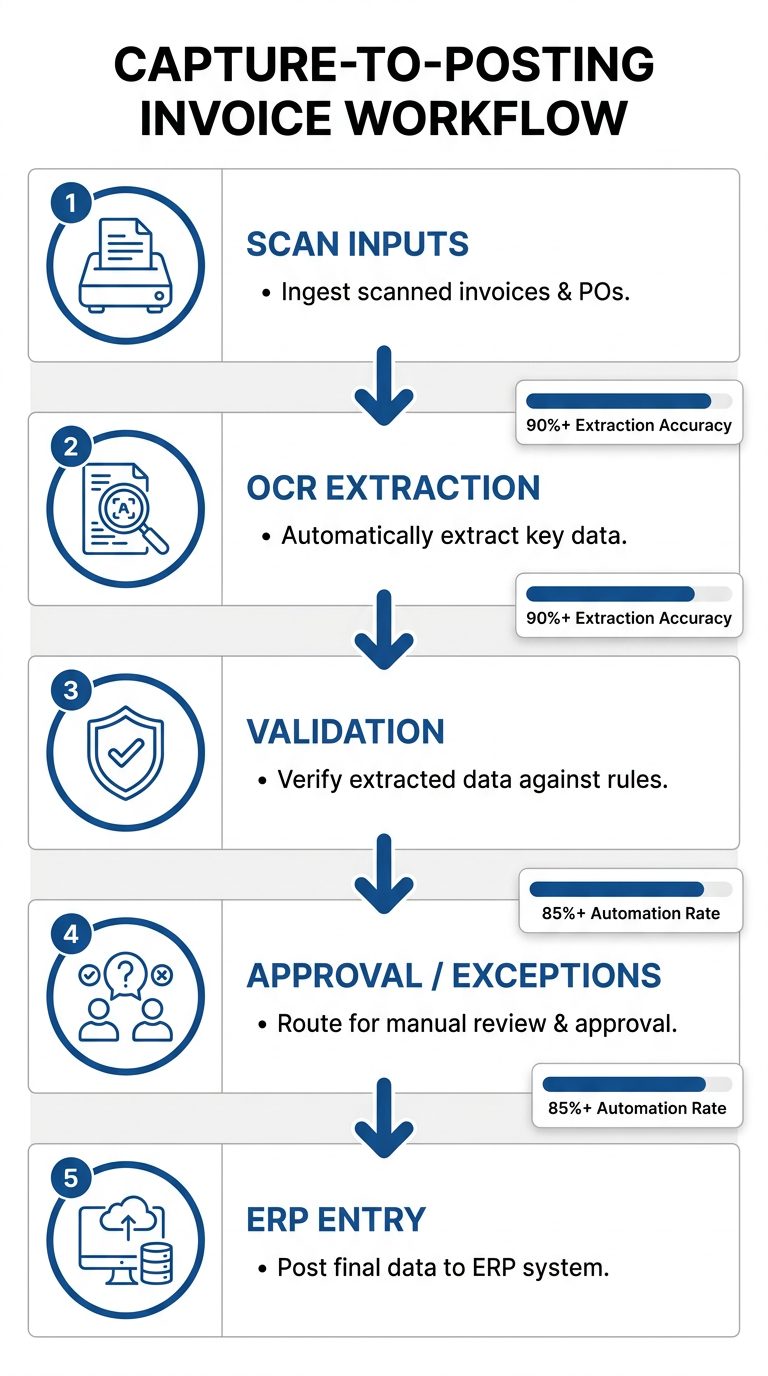
Where RPA Adds Control After OCR Capture
RPA’s role in exception handling and approval routing after OCR data capture is to validate extracted fields against business rules, direct flagged documents to named owners, and post clean records straight through without human review when the data meets the confidence threshold. How well that routing is governed determines whether automation reduces risk or simply relocates it.
Human-in-the-loop automation research shows a consistent pattern: routing every record to a human reviewer increases perceived confidence but reduces overall decision accuracy, because reviewers tend to miss or undercorrect large errors. That finding points to a better model, one where bots handle straight-through documents automatically and surface genuine exceptions for human judgment only.
Here is where RPA does its clearest work in a governed workflow:
- Flag data problems before they reach your ERP. RPA checks each OCR output against business rules, catching missing fields, mismatched line totals, and low-confidence extractions before a bad record posts to a downstream system. iTech’s invoice processing automation uses confidence scoring thresholds to separate records that are safe to post from those that need a second look.
- Route exceptions to the right person, automatically. Rather than landing in a shared inbox, flagged documents go directly to the plant, procurement, or finance stakeholder responsible for that supplier or cost center. Predefined routing rules tied to document type, value threshold, or exception category make approvals faster and more consistent across facilities.
- Protect straight-through processing for clean documents. Not every invoice needs human review. Separating high-confidence, rule-compliant documents from exceptions means your team spends time on judgment calls rather than on records the system can handle reliably. iTech’s logistics document automation reports 31–61% faster processing cycles when straight-through and exception workflows are clearly separated.
- Reduce downstream disruption from upstream errors. In manufacturing, a mismatched purchase order line can delay a goods receipt or stall a production run. iTech’s EDI exception management approach applies the same principle: catch and remediate data errors at the point of entry, before they propagate into inventory or finance records.
- Support governance with clear ownership. Critical success factors for RPA consistently include defined process ownership and exception accountability. Bots should not just route exceptions; they should log who received them, when action was taken, and what the resolution was. That audit trail is what makes automation defensible in a compliance review.
In a manufacturing IT environment, RPA is the control layer after OCR capture, the mechanism that makes automation both fast and defensible. When approval routing is rule-driven, and exception queues are assigned to named owners, the workflow gains both speed and accountability.
FAQs: Compliance, Audit Trails, and Visibility
Speed creates a new accountability problem. When a document moves through four automated steps in under a minute, reconstructing what happened and who approved it becomes difficult after the fact. Manufacturing IT teams in regulated environments need a clear record of every decision the system made, not just confirmation that automation ran.
How do OCR and RPA support compliance and audit trails in data entry automation?
Both technologies produce structured, timestamped records at each processing step. RPA automatically logs every validation check, field change, and routing decision. That log serves as your evidence for audits under frameworks such as HIPAA, GDPR, or SOC requirements. iTech’s 3-way match automation shows how this works in accounts payable compliance.
What should teams track to prove who captured, changed, approved, and exported each record?
A complete audit trail captures the user or bot identity, the action taken, a timestamp, and the field value before and after any change. Audit trail guidance calls for tamper-resistant logs retained long enough to satisfy your regulatory obligations. Without those four data points, traceability gaps become audit findings.
Does automation make it harder to spot errors before they reach downstream systems?
The opposite is true when the workflow is governed correctly. RPA-automated workflows are repeatable and logged. IFAC’s examination of automation in audit finds that it makes anomalies easier to isolate than manual workflows, where errors often remain invisible until they cause downstream problems.
How can manufacturing IT connect automated document workflows to existing ERP and quality processes without losing control?
Integration works best when the automation layer validates data before it commits to the ERP, not after. iTech’s back-office order-processing approach uses role-based access controls and exception queues, so IT teams retain approval authority over what enters production systems.
How does real-time visibility work across plants or departments?
Dashboards tied to the RPA workflow surface queue status, exception counts, and approval backlogs in real time. Teams at different facilities see the same data without waiting for a report. That shared visibility is what separates a governed automation workflow from a tool that runs in the background and generates surprises.
Build a Governed Data Entry Automation Workflow
OCR and RPA deliver measurable results, faster processing cycles, fewer downstream errors, and defensible audit trails when they operate as a governed, end-to-end workflow rather than independent tools. Research on RPA governance frameworks identifies access controls, change management, and continuous monitoring as the internal controls that keep automation accurate and auditable over time. Accuracy at the capture stage, intelligent routing, and shared visibility reinforce one another, and that combination makes data entry automation defensible at scale.
iTech Data Services builds that governance directly into its AI-enhanced OCR and automation solutions, machine-learning-paired models trained for industry-specific document types, compliance controls aligned with GDPR, HIPAA, and SOC requirements, and 24/7 support, so your team never loses visibility into what the workflow is doing. The result isn’t just faster processing. It’s a workflow where every record is traceable, every exception has a named owner, and your organization can scale document volume without scaling risk. Explore iTech’s Data Entry Automation solution to see how it fits your environment.
No Comments