

Read Time: 10 minutes
Key Takeaways:
- Intelligent document processing (IDP) takes the grunt work out of manufacturing workflows. Instead of manually keying in data from invoices, work orders, and quality docs, IDP automates the whole capture process. That cuts down on errors and frees up your team for higher-value work.
- With AI doing the heavy lifting, you get real-time analytics, compliance-ready audit trails, and secure handling of sensitive records baked right into your workflows. That means fewer headaches when auditors come knocking.
- The smartest way to get started? Pick one high-volume document type, run a focused pilot, prove it works, and then scale out across your plants. Most manufacturers see ROI faster than they expect.
If you’ve spent any time on a manufacturing floor, you know the drill: stacks of invoices, work orders piling up, quality reports that need manual entry. It’s tedious, it’s error-prone, and it’s a bottleneck that slows everything down. That’s exactly where intelligent document processing comes in. It converts all those paper and digital documents into clean, actionable data that actually keeps pace with your production line.
Manufacturers who’ve adopted intelligent document processing are already seeing faster cycle times, fewer mistakes, and tighter compliance. The technology brings together machine learning-powered data capture with the MES and ERP systems you’re already using. Whether you’re organizing engineering blueprints or automating invoice processing, there are real, practical use cases that can take you from pilot to full-scale deployment without the guesswork.
Ready to see it in action? iTech Data Services offers AI-enhanced OCR built specifically for manufacturing environments, so you can stop wrestling with paperwork and start moving faster.
What Is Intelligent Document Processing in Manufacturing?
Let’s break it down simply. Intelligent document processing combines three technologies that work together to eliminate paper-heavy manual work. First, OCR technology reads text and data from scanned documents. Then, machine learning models figure out what kind of document it is and pull out the specific fields you need, getting better at it over time. Finally, workflow automation pushes that captured data straight into your business systems, no manual entry required. According to Databricks, this integrated approach can hit high accuracy rates on standardized documents while handling large volumes efficiently.
In manufacturing, this matters a lot. Your operations churn out huge volumes of supplier invoices, work orders, quality certificates, and maintenance logs every single day. All of that used to require someone sitting down and typing it in. IDP connects those documents directly to your ERP and MES systems, giving you real-time visibility across production and supply chain workflows. Successful implementations tend to focus on training models for your specific industry, locking down data security, and tracking KPIs like processing accuracy. Companies using automated document indexing and AI-driven data capture are reporting meaningful reductions in cycle times and much better compliance readiness.
Accelerate Data Capture With AI-Powered Extraction
Here’s where things get exciting. You can deploy AI-powered extraction models that are specifically trained on manufacturing documents: engineering drawings, packing slips, and work orders. Research shows that OCR systems optimized for mechanical drawings achieve over 90% detection accuracy. That means you can cut manual data entry by 30 to 70%. These specialized models actually understand manufacturing-specific layouts, technical symbols, and part numbering conventions that generic OCR tools just can’t handle.
The smart part? Confidence scoring. The system auto-approves high-certainty extractions and only sends the tricky ones to a human reviewer for a quick check. We recommend starting with a focused 14-day pilot on your highest-volume document type. That gives you real, measurable proof that it works before you scale up. This approach lets you test performance on technical drawings and build confidence across your team with proven automation solutions.
Streamline Payables via Automated Invoice Processing
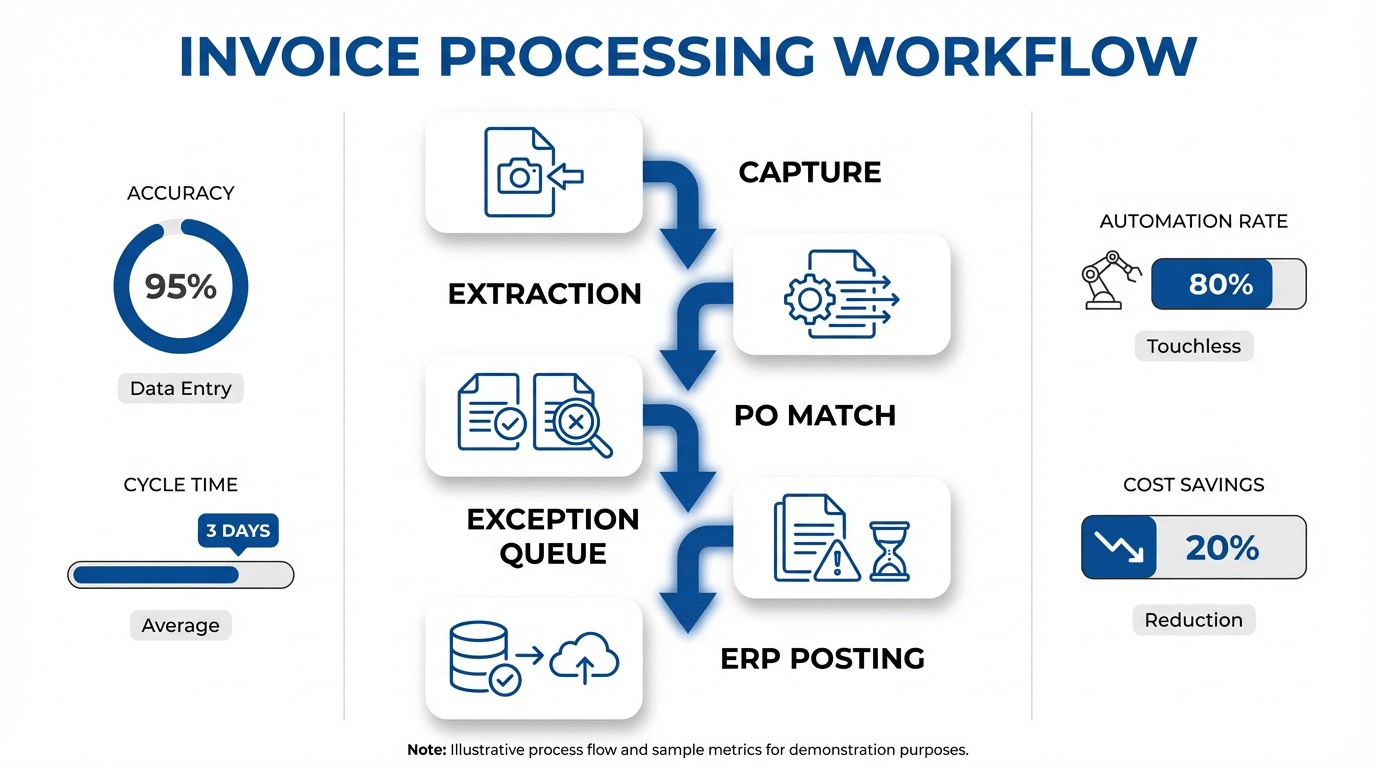
Let’s talk invoices. Manufacturing companies deal with thousands of supplier invoices every month, and each one needs manual data entry, PO matching, and approval routing. It’s a huge time sink. Automated invoice processing changes the game by capturing invoice data the moment invoices arrive, whether by email or scan, and routing it through your existing approval workflows automatically.
- Auto-extract header and line-item data from supplier invoices, including vendor details, PO numbers, part numbers, quantities, and pricing. This alone can reduce data entry errors by up to 70%.
- Enable straight-through processing with ERP integration that automatically matches invoices to purchase orders and receipts. We’re talking automated 2-way or 3-way matching that can cut cycle time by 38%.
- Apply vendor-specific learning so extraction accuracy improves across varied invoice layouts, multi-currency formats, and supplier-specific terminology. It gets smarter with every batch.
- Reduce late payment fees by automatically flagging invoices that are approaching payment terms and routing urgent approvals to the right people before deadlines hit.
- Create audit-ready documentation with complete processing trails that capture every extraction, validation, and approval step. This supports compliance and makes invoice auditing a breeze.
Orchestrate Shop-Floor Docs With Workflow Automation
Paper shuffling between stations? That’s yesterday’s manufacturing. Effective workflow automation digitizes work instructions, change notices, and material certifications right at the point of capture. AI-enhanced OCR extracts the key data and routes documents to the right cell or workstation based on your predefined rules. Operators get accurate, up-to-date information exactly when they need it, which is exactly the kind of digitalization that drives real efficiency gains.
When the system captures data points like lot numbers, revision codes, or part specs, it automatically triggers task creation in your MES or ERP. Machine learning models trained on manufacturing documents recognize these patterns and immediately update production schedules, quality checkpoints, or inventory records. And when exceptions pop up, standardized templates route them to supervisors with all the context they need. No more ad hoc emails and phone calls slowing down production workflows.
Gain Visibility Through Real-Time Document Analytics
Your plant processes thousands of work orders, quality records, and supplier documents every day. But when processing bottlenecks go undetected, they can derail production schedules before anyone notices. Real-time document analytics turns that information flow into intelligence you can actually act on.
- Deploy interactive dashboards that track processing throughput, accuracy rates, and exception volumes by department. Supervisors can see immediately where manual interventions are slowing things down.
- Correlate information cycle times with production delays using machine learning approaches to figure out which bottlenecks actually impact your manufacturing schedule, and prioritize automation spending accordingly.
- Set up proactive alerts when processing times exceed SLAs or compliance thresholds are getting close to risk levels. Catch quality escapes and regulatory issues before they hit the production floor.
- Monitor exception patterns to spot recurring rejection hotspots. This lets you fine-tune your OCR models and cut manual touch points by up to 40%.
- Implement automated indexing with data capture automation that feeds searchable records directly into your analytics platforms, giving you 60x faster access to production-critical information.
- Generate weekly accuracy audits and quarterly business reviews that tie processing metrics directly to operational KPIs. This builds a clear ROI story for expanding data entry automation to more document types and additional sites.
Improve Accuracy With OCR Tuned for Manufacturing
Generic OCR just doesn’t cut it in manufacturing. Standard tools stumble on the unique challenges of industrial documents, but OCR designed specifically for manufacturing environments delivers real, measurable improvements. Modern systems pair traditional character recognition with layout-aware models that understand spatial relationships in technical drawings, part specifications, and supplier certifications. Research confirms that OCR tuned for engineering drawings can achieve over 90% detection accuracy on complex technical documents. These systems are great at capturing small-font tolerances, multi-language labels, and barcodes that standard OCR tends to miss.
What really makes it valuable is continuous learning. Manufacturing facilities have unique challenges: equipment stamps, quality watermarks, and wear patterns that generic OCR simply can’t handle reliably. Advanced systems learn from these plant-specific variations and get better over time, reducing exceptions and manual corrections. Studies show that combining object detection with specialized OCR for industrial labels significantly boosts field-level accuracy, making automated processing practical even for the toughest document types.
Embed Compliance With Ready-to-Audit Processing
Regulatory oversight keeps growing, especially if you’re in pharma, medical devices, or aerospace. The good news? Compliance-ready data processing can build audit readiness directly into your document workflows. So when inspectors show up, your evidence is already organized and waiting. Solutions like iTech’s Data Entry Automation include these controls by design.
- Implement role-based access controls that restrict who can view and edit documents based on job function, with automatic logging of every access event. This meets FDA Part 11 requirements for electronic records.
- Apply encryption in transit and at rest for all sensitive manufacturing documents, keeping data protected throughout the entire lifecycle per 21 CFR Part 11 standards.
- Create immutable audit trails that capture every document action, approval, and modification with timestamps and user IDs, providing the tamper-evident logging recommended by NIST guidelines.
- Automate retention policies for regulated records like batch records and safety documentation, with built-in alerts before expiration dates so nothing gets accidentally deleted.
- Standardize evidence collection across all document types so every approval workflow, exception, and change control creates a complete paper trail that auditors can follow from start to finish.
Advance Paperless Operations Across the Plant
Converting paper travelers, inspection sheets, and maintenance logs to digital workflows isn’t just a nice-to-have. It’s a game-changer for shop-floor efficiency. Point-of-work kiosks and mobile devices let operators scan or photograph forms on the spot, instantly populating work orders and maintenance schedules through direct connections to your MES and CMMS systems. Research on paperless operations shows measurable reductions in processing time and error rates when organizations ditch paper for digital.
The key to expanding? Measure touch time before and after digitization. Track document processing speed, error rates, and how much time operators spend on admin tasks. That’s the concrete ROI data you need to justify rolling this out across more production lines. The evolution of manufacturing operations software increasingly supports AI-enabled document capture that plugs right into your existing plant systems, making the jump from pilot to full-scale much more predictable.
Elevate Quality With Machine Learning-Assisted Checks
Quality control gets a serious upgrade when machine learning analyzes incoming supplier documentation alongside your production workflows. By examining patterns in certificates of analysis, inspection reports, and material specs, intelligent systems can flag potential issues before materials even enter your production process.
- Auto-validate incoming materials against specifications. Compare lot numbers, tolerances, and material properties from supplier certificates directly against your master data. Catch mismatches that could cause production delays or let defective products reach customers.
- Flag anomalies in supplier documentation using learned patterns. Advanced detection algorithms identify unusual values in certificates of analysis or inspection reports, things like unexpected test results or missing required fields that human reviewers might overlook.
- Generate supplier feedback loops that reduce future nonconformances within 70 days. Track patterns in supplier quality issues and automatically generate performance reports, helping vendors understand recurring problems and fix them within that targeted timeframe.
- Integrate quality insights with production planning systems. Connect document-based quality data with your MES and ERP through automated data entry processes, enabling real-time decisions about material acceptance and scheduling based on anomaly detection results.
- Build confidence scores for automated approval workflows. Machine learning assigns reliability ratings to incoming quality documents, automatically approving the clear-cut items while routing anything uncertain to quality engineers for a closer look.
Scale From Pilot to Enterprise With Modular Automation
Don’t try to boil the ocean. Start with a hub-and-spoke approach: pick one high-volume document family, like invoices or work orders, for your initial deployment. Once you’ve validated accuracy and exception handling, replicate the same templates and connectors across other plants and document types. This modular automation approach reduces risk while proving your team can manage scalable document automation.
As you expand, design governance frameworks that balance standardization with local flexibility. Share core ML models while allowing site-specific exceptions for unique processes. Track per-site KPIs like accuracy rates and exceptions per 1,000 documents to guide your rollouts and secure funding for the next phase. Companies typically see 6 to 9 month breakeven periods when they measure both productivity gains and business impact across all sites.
Protect Sensitive Records With Secure Data Capture
Manufacturing documents are full of sensitive information: supplier contracts, employee records, proprietary specs, customer data. You need security controls that protect all of it without making life harder for the operations teams who need access every day.
- Deploy SOC 2 certified controls with role-based access, encryption at rest and in transit, and comprehensive audit logging to protect supplier contracts and employee information while staying compliant.
- Implement GDPR-compliant data handling with automated consent tracking, data subject rights management, and retention policies that automatically purge records on schedule.
- Apply field-level redaction and tokenization to mask sensitive data like social security numbers or proprietary formulations while keeping document structure intact for analytics and reporting.
- Enable continuous access monitoring with automated alerts that flag unusual login patterns, bulk downloads, or after-hours access within 14 minutes. This helps contain potential security incidents before data exposure occurs.
- Maintain data security oversight through regular penetration testing, vendor security assessments, and separation of duties between IT operations and security monitoring teams.
Intelligent Document Processing FAQs for Manufacturing
If you’re a manufacturing IT leader looking into intelligent document processing, you probably have some specific questions about how this actually works in a production environment. Here are the ones we hear most often.
Which documents should manufacturing teams automate first?
Go for the low-hanging fruit: high-volume, standardized paperwork like supplier invoices, purchase orders, and work orders. These typically deliver the quickest returns because the data fields are clear and you’ve already got validation rules in place. Quality records and engineering drawings make great second-phase targets once your initial workflows are running smoothly.
How does IDP integrate with existing ERP and MES systems?
Through standard APIs and web services, so no disruptive system overhauls are needed. Data flows directly into your ERP for financial records or your MES for production files. AI-enhanced OCR validates against master data before posting, which cuts down on integration errors and keeps your data quality high.
What accuracy levels are realistic, and how are exceptions handled?
You can typically expect 85 to 95% precision on standardized files with clean layouts. Human-in-the-loop systems handle the exceptions efficiently. Confidence scoring automatically routes uncertain fields for review while processing clear data right away. The system keeps learning and improving over time, especially with industry-specific training on your manufacturing document formats.
How does IDP support compliance and audit readiness?
Every document transaction gets a permanent audit record: who processed what, and when. Role-based access controls and encryption protect sensitive data, while automated retention policies handle regulated records on their own. Digital transformation in procurement research shows that automated auditing consistently outperforms manual processes when it comes to compliance precision.
What timeline and resources are common for pilots versus multi-plant rollouts?
A focused 14-day pilot usually takes 2 to 3 team members and targets one document type to validate precision and integration. Multi-plant rollouts typically span 3 to 6 months, depending on how complex things are and how much change management you need. Successful AI pilots consistently emphasize data readiness and clear success metrics before scaling across locations.
From Pilot to Production: Your Next Step With IDP
Manufacturing leaders who implement intelligent document processing see results quickly: better accuracy, stronger compliance, and faster cycle times. The path forward is simpler than you might think. Pick one high-volume, high-friction document type, like invoices or work orders, and run a focused pilot. Research shows that successful AI scaling comes down to clear use-case selection and measurable outcomes from day one.
Building on that success takes the right foundation. Data entry automation for manufacturing works best when it’s built on industry-specific machine learning models and secure processing pipelines. Companies that choose solutions with proven governance frameworks and compliance controls can scale from pilot to enterprise-wide deployment in months, not years. Having a technology partner who actually understands manufacturing makes all the difference between a proof-of-concept and real production success.
Ready to leave manual document processing behind? Start your pilot with iTech Data Services and experience AI-enhanced OCR built specifically for manufacturing workflows.
No Comments