

Read Time: 4 minutes
Key Takeaways:
- Automated EDI exception management significantly reduces manual errors and operational disruptions in manufacturing by intelligently routing and resolving document discrepancies.
- AI-powered document processing and real-time dashboards enable proactive decision-making, improved compliance, and measurable efficiency gains.
- Integrating exception management automation with existing ERP and MES systems streamlines workflows, maintains data security, and accelerates ROI for manufacturing organizations.
EDI errors in manufacturing can quickly escalate from minor discrepancies into larger operational challenges. Delays caused by missing documents or mismatched data often require time-consuming intervention, affecting production schedules and overall efficiency. A more structured approach to handling these exceptions helps reduce disruptions and improve accuracy across workflows.
At iTech Data Services, EDI exception management is built around automation that reduces manual intervention while improving data consistency across systems. The sections ahead explore how exception handling works in manufacturing environments, including common error types, automation strategies, and the operational impact of resolving discrepancies faster.
Improving Manufacturing Efficiency With Automated EDI Exception Handling
When your production line stops due to a missing ASN or a price mismatch, every minute costs money. Manufacturing IT directors often ask: How does EDI exception management service improve manufacturing efficiency? The answer lies in replacing reactive manual processes with intelligent automation that prevents disruptions before they impact operations.
Intelligent Exception Routing Prevents Manufacturing Disruptions
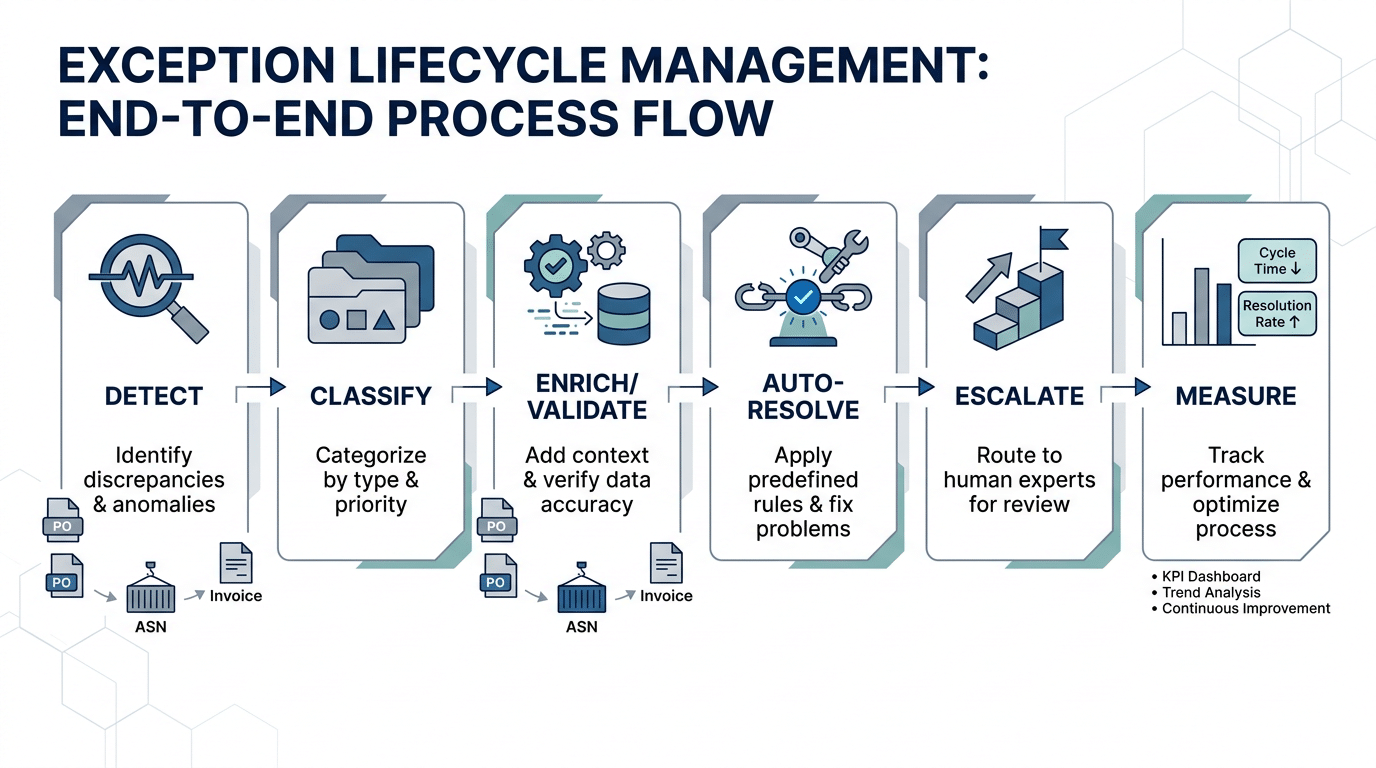
Automated triage systems categorize exceptions by type and severity, then route them automatically to the appropriate team member with built-in SLA timers. Price mismatches go directly to procurement, missing ASNs alert receiving staff, and unit-of-measure conflicts reach inventory planners within minutes. This targeted approach prevents dock bottlenecks and keeps manufacturing schedules on track.
Smart Document Processing Reduces Manual Entry Errors
Modern EDI exception management uses smart document reading technology and automatic checking rules to match incoming documents against master data. This approach reduces manual keying requirements by up to 80% and catches discrepancies before they become costly shop floor issues.
Companies implementing machine learning in their data processes report capture accuracy of up to 99%. These systems maintain full audit trails for GDPR, HIPAA, and SOC compliance requirements.
Real-Time Visibility Enables Proactive Manufacturing Decisions
Centralized dashboards provide planners and accounts payable teams with immediate exception status updates and trend analysis. Instead of reactive firefighting, teams can spot patterns and address root causes before they impact manufacturing flow. This real-time approach to supply chain monitoring enables predictive responses that protect both on-time delivery and cash flow management across all business operations.
Common EDI Exceptions and How Automation Resolves Them
Missing or late ASN documents cause costly receiving delays and inventory discrepancies, disrupting production schedules. Automated systems detect these gaps and trigger supplier notifications. They also advance receiving with risk flags when EDI fails, while RPA fetches ASNs from supplier portals. PO and invoice mismatches get resolved by automatically standardizing measurements, package formats, and acceptable variance ranges.
Beyond document timing issues, data quality defects disrupt manufacturing workflows when vendor IDs are incorrect or product codes contain errors. Automation fills in missing data, corrects common errors, and quarantines high-risk records for review.
Organizations implementing automated exception handling typically see 40-46% reductions in exception resolution time within the first quarter, depending on their current automation level.
 EDI Exception Management FAQs for Manufacturing IT
 EDI Exception Management FAQs for Manufacturing IT
Building on the automation benefits outlined above, Manufacturing IT leaders often need specific guidance on implementation priorities and measurable outcomes. These answers address the most common concerns about EDI exception management compliance and data accuracy in production environments.
Which EDI documents benefit most from exception automation in manufacturing?
Purchase Orders (850), Purchase Order Acknowledgments (855), and Advanced Ship Notices (856) deliver the greatest operational impact. These documents directly affect production scheduling and receiving workflows. Invoice exceptions (810) also provide significant value by reducing payment delays and chargebacks.
How does the service maintain compliance and data security without slowing operations?
Modern EDI exception management operates within existing security frameworks like SOC and GDPR requirements. Automated validation rules run in real-time, without manual intervention. Audit trails capture all exception handling activities while maintaining processing speed through automated background workflows.
Which KPIs should we track first, and which improvement targets are realistic?
Start with first-pass match rate, exception backlog age, and mean time to resolution. Manufacturing clients typically achieve 40-46% improvements in these metrics within the first quarter, with full ROI realized within 6-8 months. Track exception volume by document type to identify the biggest impact areas.
How does it integrate with ERP and MES systems without disrupting workflows?
Integration happens through standard APIs and middleware connections to systems like SAP, Oracle, and other major ERP platforms. The service monitors EDI transactions alongside current processes. Exception alerts route directly to appropriate teams while maintaining your established approval workflows and user interfaces.
Putting It Into Practice: Start With High-Impact Exceptions and Clear KPIs
Handling EDI exceptions in manufacturing becomes far more effective when automation is introduced across document processing, validation, and resolution workflows. With centralized dashboards and intelligent routing, teams gain better control over exception handling while maintaining compliance and improving overall operational performance.
To maximize these governance efforts and prevent issues at their source, consider pairing your management strategy with automation that validates documents before they enter EDI workflows. Take your approach further with AI-driven automation from iTech Data Services to eliminate manual data entry errors while maintaining compliance and data accuracy in manufacturing operations.
No Comments