

Read Time: 6 minutes
Key Takeaways:
- A US-based AP provider is worth the premium when your team needs same-business-day exception handling, clearer ownership, and SLA-backed responsiveness that offshore handoffs often slow down.
- The right provider strengthens compliance by building controls, audit trails, role-based access, and documented security responsibilities into the invoice workflow instead of adding manual review after the fact.
- The strongest 2026 model pairs US-based accountability with AI-driven capture and reporting, giving AP teams real invoice visibility, fewer data-entry errors, and scalable support during volume spikes.
Manual invoice entry and approval bottlenecks remain the top pain points for AP teams, even as AI adoption accelerates. For logistics operations handling high invoice volumes, that daily friction doesn’t just slow payments. It creates supplier disputes, missed discounts, and audit exposure that a low-cost provider halfway around the world can struggle to resolve before your business day ends.
Most teams frame this as a cost question, but price alone overlooks exception delays, audit exposure, and supplier disputes. A stronger measure is whether your provider can manage exceptions, support compliance, and give your finance team real-time visibility. iTech Data Services combines US-based accountability with AI-driven automation through its data entry automation solutions.
Does a US-Based Team Resolve AP Issues Faster?
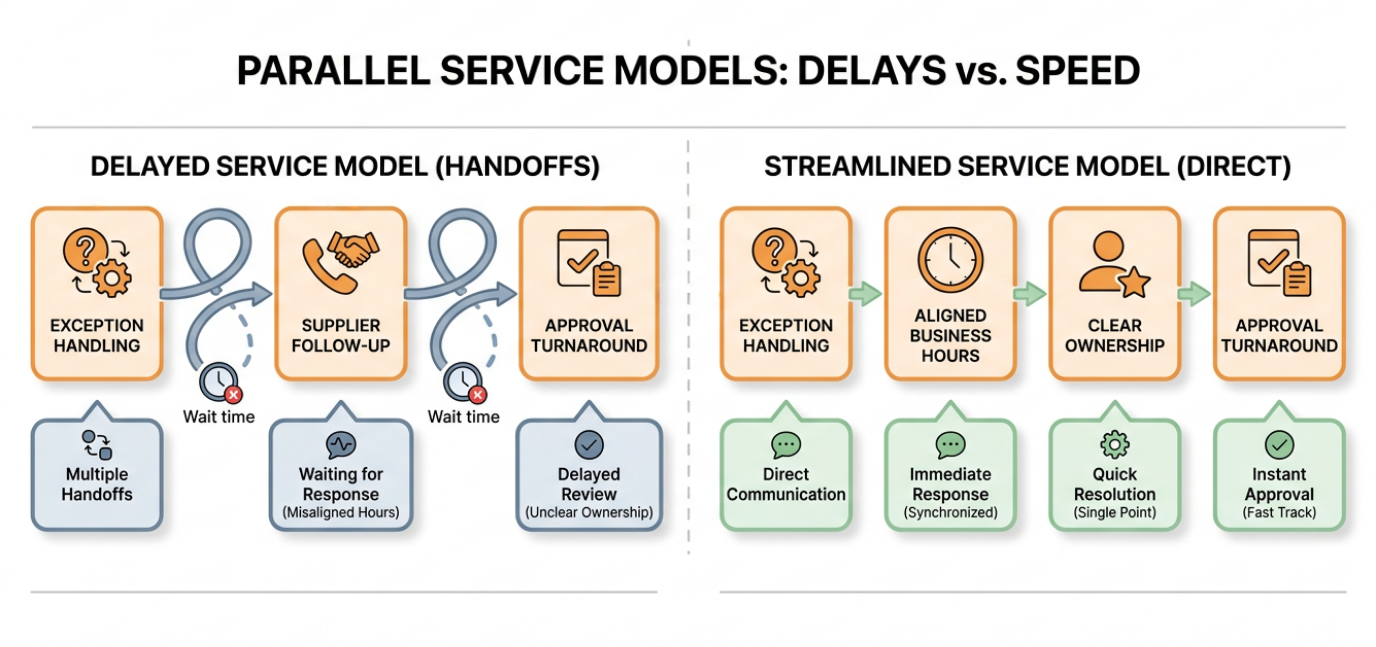
For logistics operations teams managing high invoice volumes, how quickly AP issues are resolved directly affects supplier relationships, payment terms, and freight schedules. The answer often comes down to two things: time zone alignment and faster issue resolution through clear service ownership.
Does time zone alignment actually reduce invoice approval delays?
Yes, and research supports it. Even a one-hour time zone gap measurably reduces synchronous communication, and AP exceptions are non-routine work that requires real collaboration. A US-based provider aligned to your business hours can catch and resolve freight invoice discrepancies the same day they surface, not the morning after.
When exceptions pile up, does a US-based provider give clearer day-to-day ownership?
Follow-the-sun models distribute work across shifts, which can blur accountability when an issue crosses handoff points. A US-based team operates within a single service window, so one team owns the problem from start to finish. APQC benchmarks put the median exception-to-resolution cycle at five working days; providers with clear ownership consistently close that gap.
Which AP tasks benefit most from same-business-day access?
Freight invoice discrepancies, urgent payment status checks, and approval bottlenecks all require real-time coordination between AP, procurement, operations, and sometimes suppliers directly. These tasks cannot wait for an overnight handoff. Exception-handling workflows with defined routing and same-day access meaningfully compress resolution time.
How does a US-based team improve cross-department coordination?
When an AP issue affects procurement, operations, and a supplier simultaneously, ensuring all parties are reachable during the same business hours matters. US-based providers can join calls and loop in the right contacts without a lag. Coordination breaks down quickly when your provider is six or eight time zones away.
What service-level commitments should your contract include?
Vague support promises are not SLAs. Look for specific commitments on exception turnaround time, supplier inquiry response windows, and escalation paths with named contacts. iTech’s managed invoice processing model ties SLA strictness to defined cost tiers; knowing those targets upfront gives your team a real basis for holding a provider accountable.
Will a US-Based Provider Improve Compliance and Control?
Most freight AP compliance failures start in the workflow, weeks before an audit. A mismatched line item clears review, an approval bypasses a threshold check, or a duplicate payment goes unnoticed until reconciliation. When a provider embeds compliance and regulatory oversight at intake, the audit trail is already clean when it is needed. That is more effective than adding controls only after the work is done.
How does a US-based AP outsourcing provider support AP compliance and regulatory oversight without adding extra manual review?
A well-structured provider embeds AP compliance and regulatory oversight directly into the workflow; tolerance thresholds, role-based access, and automated exception routing catch issues before they require manual intervention. 3-way match automation is a practical example: it flags discrepancies at intake, reducing the manual review burden while preserving the audit trail.
What internal controls should the provider document across the invoice lifecycle?
Expect documented controls at every stage: invoice intake, approval routing, payment readiness, exception handling, and audit trail generation. PCAOB Auditing Standard No. 5 makes it clear that auditors will test walkthroughs, reperformance, and system logs, so controls that exist only in policy documents will not hold up. Your provider should be able to produce evidence, not just descriptions.
How should data security responsibilities be split between your team and the provider?
Your provider should own encryption, multi-factor authentication, breach notification protocols, and access reviews on their infrastructure. Your internal team retains responsibility for defining data classification rules, approving vendor access levels, and confirming data residency requirements are met. NYDFS guidance recommends making these splits explicit in the contract, including subcontractor disclosure and AI-use terms.
Which certifications signal that compliance-minded handling is built into how a provider operates?
A SOC 2 Type II report is the baseline; it covers the AICPA’s Trust Services Criteria and demonstrates that controls were tested over time, not just at a point in time. Request the full report, not a summary, and verify that the auditor’s scope covers the specific AP processes you are outsourcing.
Does a US-based model make audits and policy enforcement more straightforward?
Shared business hours, direct communication paths, and named escalation owners reduce the back-and-forth that slows audit response. When your internal audit team needs a walkthrough or a log pulled, a US-based provider can respond on the same day. That accountability is harder to replicate across time zones and handoff layers.
Can a US-Based Provider Deliver Better Visibility and Scale?
Compliance and accountability matter at the control level, but the daily value of a well-chosen provider shows up in what you can actually see: invoice status, exception queues, and workflow performance in real time. When freight volumes shift with seasons and contract changes, the gap between a basic outsourcing arrangement and one built on automation is where AP performance either holds or breaks down.
How does visibility differ between a basic outsourcing model and one that includes AI-driven automation?
A basic model tells you that invoices were processed. An automation-backed model shows you where each invoice is, why it was flagged, and how long it sat in the queue. Providers that combine service delivery with AI-driven capture give your team on-demand analytics rather than end-of-month summaries that are too late to act on.
What dashboards and reports should your team realistically expect?
At minimum, expect real-time invoice status tracking, exception queue volumes, turnaround times by invoice type, and root-cause breakdowns of recurring errors. iTech’s iClarify platform gives clients on-demand access to these metrics, so finance and operations leadership can review workflow performance without waiting on a provider report cycle.
How does AI-enhanced OCR improve invoice accuracy before a human ever touches it?
AI-enhanced OCR reads and structures invoice data at intake, catching formatting inconsistencies, missing fields, and mismatched values before they reach an approver. That reduces rework downstream. In high-volume freight environments, that kind of early-stage accuracy means fewer exceptions reaching your team and faster payment cycles overall.
Can a US-based provider using automation still be cost-effective?
Yes. When automation handles repetitive capture and validation work, the service model becomes more efficient, not just more expensive. Labor cost per invoice drops as volume scales, and your team spends time on exceptions that genuinely need judgment rather than manually correcting data entry. The AP outsourcing guide for manufacturing leaders breaks down this cost-per-invoice model in detail.
What signals show a provider can handle freight spikes and workflow changes without losing control?
Ask whether their model is built to flex, specifically, whether SLAs hold during peak periods and whether new approval workflows or business units can be onboarded without a full re-implementation. A provider that documents its capacity thresholds and shows you performance data across volume fluctuations is a more reliable answer than one that promises scalability without evidence.
Choose the Model That Gives AP More Control, Not Just Lower Cost
The cost-per-invoice argument for offshore AP looks straightforward until exception volumes climb, an audit surfaces a control gap, or a supplier escalates a payment dispute, and your provider isn’t reachable until tomorrow morning. At that point, what looked like margin becomes friction, and the savings are harder to quantify than the damage.
For freight-heavy operations running high invoice volumes, the model that holds pairs US-based service accountability with automation that catches errors at intake, before they reach your team at all. iTech Data Services combines AI-driven invoice capture with process controls designed to reduce rework, support audit readiness, and scale when freight volumes spike.
No Comments