

Read Time: 5 minutes
Key Takeaways:
- US data entry outsourcing costs in 2026 vary widely based on skill level, compliance requirements, and turnaround times, with onshore providers commanding significant premiums over nearshore alternatives.
- AI-driven automation solutions can reduce data entry costs by 20-40% at higher volumes while improving accuracy, compliance, and integration with manufacturing systems.
- Choosing the right pricing model and balancing manual outsourcing with AI automation is essential for manufacturing leaders seeking cost-effective, compliant, and scalable data management solutions.
US onshore data entry services now command 20-40% premium rates over offshore alternatives, with costs varying significantly based on accuracy requirements and compliance standards. For manufacturing leaders evaluating outsourcing strategies, precise budget forecasts become necessary when comparing traditional services against AI-enhanced automation solutions. The following sections provide actionable cost ranges and decision frameworks for your 2026 planning.
What do US data entry services typically cost in 2026?
Manufacturing leaders need specific rate ranges, volume breakpoints, and compliance premiums to build defensible business cases for procurement and compare vendor proposals effectively. Understanding data entry outsourcing costs and US benchmarks helps you evaluate traditional manual services against emerging AI-driven alternatives.
What are the current US onshore hourly rates for different data entry skill levels?
Basic data entry ranges from $18-25 per hour, while skilled work requiring validation or complex formatting costs $28-38 hourly. Regulated environments requiring HIPAA, SOC, or GDPR compliance command $35-50 per hour due to specialized training and audit requirements.
How do per-document rates vary by volume and document type?
Simple forms cost $0.75-1.25 per document at 10k monthly volume, dropping to $0.45-0.85 at 78k volume. Complex invoices, or bills of lading, range from $1.50-2.75 per document, with AI-enhanced automation reducing costs by 30-40% at higher volumes while improving ERP integration.
What premium should you expect for 99.9% accuracy versus standard 98-99% SLAs?
High-accuracy SLAs typically add 15-25% to base rates due to dual-entry verification and enhanced quality controls. SLA verification requires documented measurement methods, performance tracking, and penalty clauses to maintain accountability and meet manufacturing quality standards.
How do turnaround requirements affect pricing across different service tiers?
Standard 3-5 day processing represents baseline pricing, while 24-hour delivery adds 20-35% premium. Same-day processing can double costs, with most providers applying expedited processing fees during peak periods or when handling complex technical documentation.
What’s the cost difference between US onshore and nearshore providers?
US onshore providers typically cost 40-60% more than nearshore alternatives, but data residency requirements and compliance mandates often justify the premium. Intelligent automation solutions address this cost differential by reducing manual labor while maintaining domestic processing and regulatory compliance standards.
Which pricing models are used and what drives rates up or down?
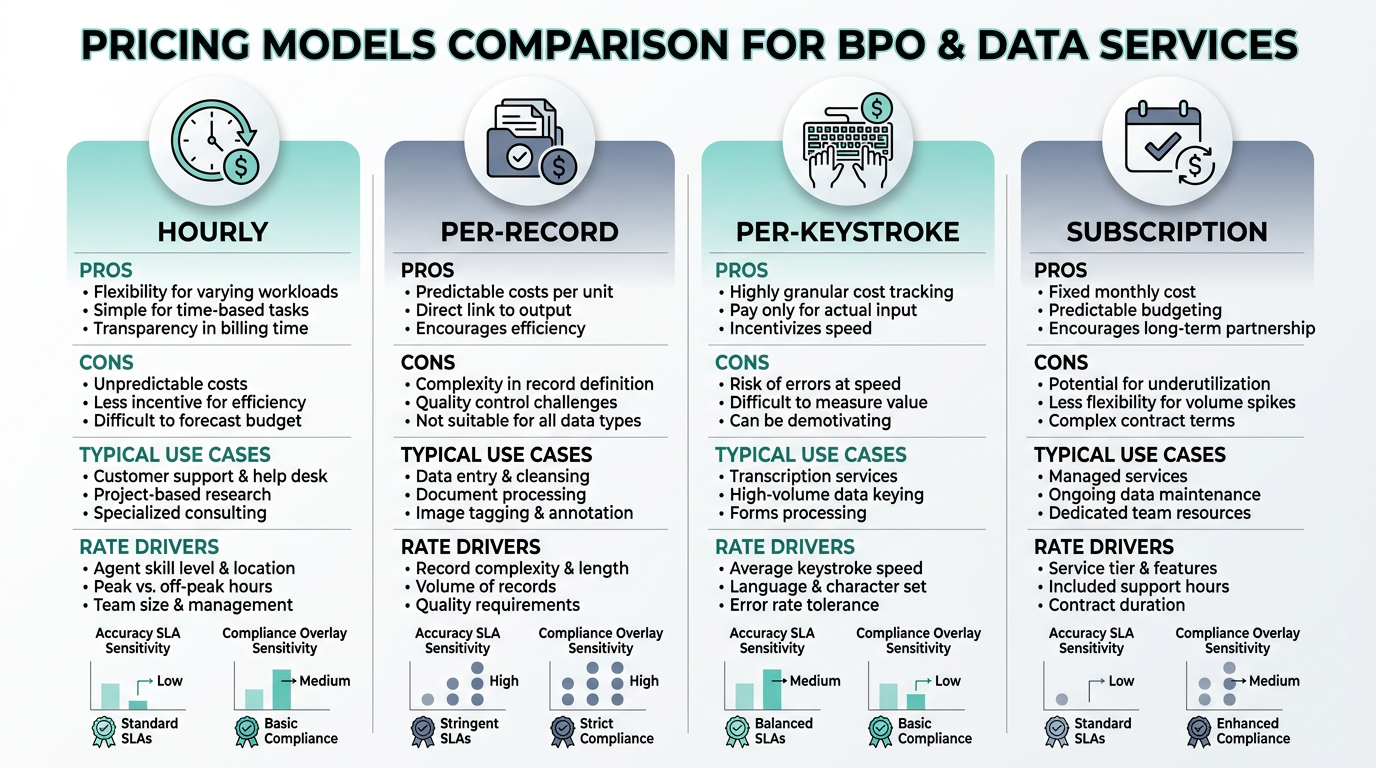
Understanding data entry pricing models helps you predict costs and compare vendors effectively. For manufacturing operations handling bills of lading, quality inspection records, and compliance documentation, choosing the right pricing structure can significantly impact your budget and operational efficiency.
What are the main pricing models for data entry outsourcing?
Most providers offer four main pricing approaches: hourly rates ($15-45/hour), per-record pricing ($0.50-3.00), per-keystroke charges ($0.01-0.05), and subscription-based managed capacity. Hourly works best for complex, variable documents. Per-record suits standardized forms like shipping manifests. Subscription models provide predictable monthly costs for high-volume manufacturing workflows.
Which factors most significantly impact data entry outsourcing rates?
Data complexity, field validation requirements, dual-entry quality assurance (where two operators independently enter the same data for accuracy), and system integrations drive the biggest rate variations. Exception handling—when documents require manual review due to poor quality or unusual formats—above 15% of total records can increase project costs by 25-40%. Research demonstrates that coordination complexity and governance requirements can increase total project costs by 20-35%.
How much do compliance requirements add to base pricing?
GDPR, HIPAA, and SOC 2 compliance typically adds 15-30% to base rates due to enhanced security controls and audit logging. Studies indicate GDPR alone increased data processing costs by approximately 20% on average. Providers with existing certifications often offer lower compliance premiums than those building new controls.
What contract structures help secure better rates?
Volume commitments, minimum monthly guarantees, and tiered pricing based on monthly volumes typically reduce per-unit costs by 10-20%. Pilot programs lasting 30-60 days allow testing before full commitment. Proper scoping of fields, formats, and exception thresholds prevents costly change orders. AI-enhanced OCR solutions can shift pricing conversations entirely by reducing manual labor requirements.
Which KPIs should guide vendor comparisons beyond price?
Focus on average handling time per document, first-time accuracy rates, error correction turnaround, and SLA adherence for time-sensitive manufacturing schedules. Effective outsourcing measurement requires automated dashboards tracking completion rates and quality metrics. Compare total cost, including rework and integration overhead, not just headline per-unit pricing.
 When does AI automation beat manual outsourcing on cost and quality?
 When does AI automation beat manual outsourcing on cost and quality?
Manufacturing leaders need clear breakeven points to choose between manual outsourcing and AI automation. These questions address volume thresholds, quality comparisons, and implementation realities that determine your most cost-effective path forward.
How should teams structure a pilot to validate ROI?
Start with a 30-60 day pilot using 2,000-5,000 representative documents to measure accuracy, exception rates, and processing speed. RPA implementations require governance frameworks and clear success metrics. Compare total costs, including setup, training, and ongoing support, against current outsourcing expenses to validate your business case.
At what volume does AI automation become more cost-effective than manual entry?
AI-enhanced OCR typically delivers 20-40% cost savings over manual entry at volumes above 15,000-20,000 documents monthly for standardized formats. Automated systems can save approximately 7 FTEs while reducing processing time by 60-70%. Complex, variable documents may require 25,000+ monthly volumes to achieve similar savings.
How do error rates compare between manual and automated workflows?
Skilled manual entry typically achieves 0.5-1% error rates, while AI workflows with human-in-the-loop validation can reach 0.1-0.5% error rates. Studies demonstrate that automated collection reduces transcription mistakes and improves data consistency. Confidence thresholds route uncertain cases to human reviewers, maintaining quality while reducing overall labor requirements.
What are realistic implementation timelines and payback periods?
Most AI automation projects require 8-16 weeks for full deployment, including system integration and staff training. Case studies show 12-week time-to-production is achievable. Organizations processing 25,000+ documents monthly typically see payback within 6-12 months, while volumes under 15,000 monthly may require 18-30 months for full ROI.
How do integration-ready outputs reduce hidden costs?
API-enabled automation eliminates manual data transfer between systems, reducing downstream handling costs by 40-60%. Direct ERP and EDI connections prevent double-entry work and associated error correction. Automated workflows provide audit trails and real-time visibility that manual processes cannot match, reducing compliance overhead.
What controls maintain compliance in automated pipelines?
AI automation can exceed manual compliance standards through consistent application of validation rules and complete audit logging. Quality controls include confidence scoring, exception routing, and systematic verification protocols. GDPR, HIPAA, and SOC requirements are built into processing workflows rather than relying on human adherence.
Choose a Cost-Right, Compliant Path Forward
Determining data entry outsourcing costs in the US requires looking beyond headline rates. The most cost-effective 2026 approach combines targeted outsourcing with AI-driven automation to achieve accuracy, speed, and compliance at the lowest total cost of ownership. Manufacturing leaders must evaluate both options based on their specific operational needs and compliance requirements.
When evaluating your options, iTech Data Services provides the transparency and flexibility you need to make confident decisions. Our approach delivers 24/7 support, full data visibility, and built-in compliance for GDPR, HIPAA, and SOC requirements. Instead of viewing outsourcing and automation as competing options, you can leverage both through our integrated solutions that adapt to your specific workflows and volumes.
Want to see exactly how AI-enhanced OCR performs against traditional outsourcing for your manufacturing data? Explore our Data Entry Automation to cut manual effort while improving accuracy and compliance. Contact iTech Data Services today to schedule a 30-minute cost and ROI assessment. We’ll tailor the analysis to your specific volumes, SLAs, and system requirements.
No Comments